
On this page
We need a more effective way to make decisions through blockchains. Agents have changed what is possible: an agent can keep working all the time and stay online for every decision, which no person can. I think this means governance no longer has to wait for us.
Agents make continuous participation possible. The next question is how to make that participation accountable. For Sapio, that starts with one decision: what a shared reserve should hold.
Most decentralized protocols make such decisions through token-weighted voting. Holders propose changes, the community deliberates, and a majority decides. The model is intuitive and it feels democratic, but for this decision it works poorly.
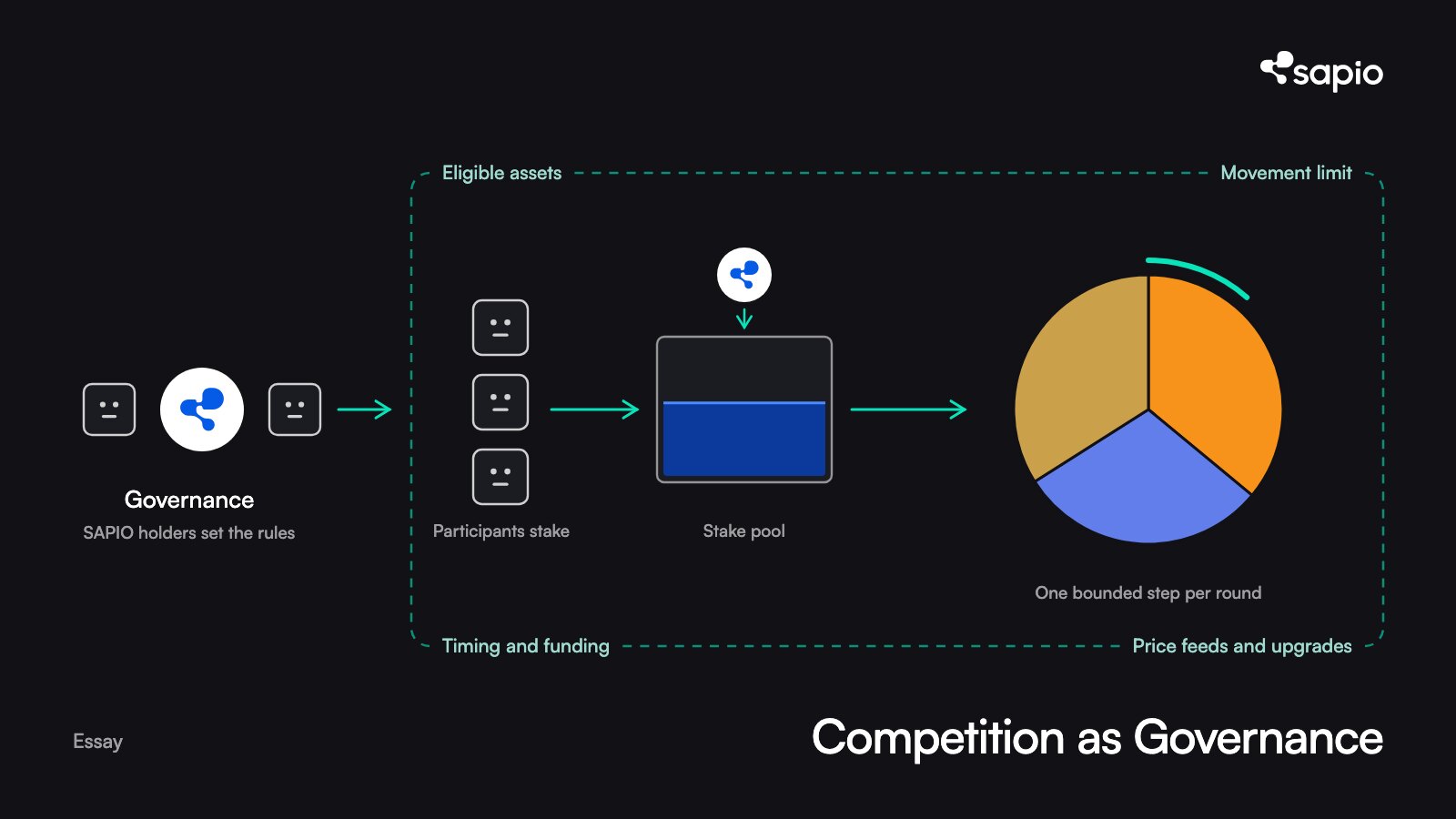
Sapio takes that decision away from the vote and gives it to a competition that runs fully on chain. Governance still exists, and it sets the rules and the boundaries. But once a round's rules are fixed, no committee or majority picks what that round buys. The participants' stakes do.
The problem with token voting on what to hold
The reserve backs SRT, the Sapio Reserve Token. Each SRT can be redeemed for a share of everything the reserve holds, so the aim is one token that works like a master key to the resources a tokenized economy runs on, such as compute, storage and bandwidth.
That economy is already large: DePINScan listed 440 infrastructure projects and more than 40 million connected devices in May 2026. Which of these tokens the reserve holds, and in what amounts, decides what an SRT gives access to and what it is worth. Token voting is a poor way to make that choice, for three reasons that come from the mechanism itself rather than from how it is implemented.
Voting well takes effort. Should the reserve add a particular token, and how much of it? Judging that well takes research that most holders cannot justify for one vote, so they vote on narratives and social signals, or not at all. A study of 21 DAOs found that in 15 of the 20 it could measure, less than half of the delegated voting power took part in the average proposal.
A few hold the votes. With one token, one vote, the largest holders decide. In 17 of those 21 DAOs, fewer than 10 participants controlled a majority of the voting power, enough to decide any vote. Sapio also weights by stake, so more capital carries more weight here too. The difference is what happens afterwards.
Outcomes do not feed back. Holders can lose when a vote goes wrong, but ordinary token voting does not move a voter's stake according to how their choice later performed. The vote is cast and the outcome arrives later, with nothing to connect the two.
Token voting
Holders vote
Weight comes from tokens held.
The outcome arrives later
The vote is not scored against it.
Weight does not follow results
Voting power is not redistributed by how the choice performed.
A Sapio round
Stake is locked first
Before anyone knows the outcome.
Judged at many points
Against the other positions and the mix at announcement (black line).
Stake moves to who scored better
More stake to bring to later rounds.
How this differs from futarchy
Using markets to govern is not a new idea. Robin Hanson proposed futarchy in 2000: vote on what we want, and let markets decide which policies will get us there. MetaDAO brings a version of it on chain, on Solana. For each proposal, the token trades in two conditional markets: one assumes the proposal passes, the other that it fails. The market that prices the token higher decides the outcome, after adjusting for a set threshold. Trades in the market that does not apply are reverted.
Sapio addresses a narrower problem: how a shared reserve should change over repeated rounds. Instead of pricing a decision before making it, Sapio makes it within limits and measures it afterwards. The yardstick is doing nothing: the protocol itself stakes on keeping the reserve as it was, and each decision is credited on its own, as explained below. What Sapio cannot see is how markets would have moved without the purchase.
How the competition works
Given what the reserve holds now, what should it add next? Each round asks that question, and participants, people or their agents, answer with stake rather than with arguments.
Commit
Participants stake SAPIO on eligible assets. The protocol stakes on the mix at announcement.
Buy
The stakes set a capped purchase target (dashed). Anyone can deliver the assets for new SRT.
Evaluate
Positions are scored against each other and the mix at announcement (black line).
Pay out
Each check pays out a share of the stakes, moving stake to the positions that did better.
- Commit. Each round opens with an announcement that fixes its prices, limits and evaluation schedule. Participants lock SAPIO, the governance token, behind an eligible asset. The protocol stakes on the reserve's mix at the announcement. That position is the benchmark, and every participant competes against it as well as against the others.
- Buy. The combined stakes move the reserve's target toward each asset in proportion to the stake behind it, within a cap per round. Anyone can deliver those assets for newly issued SRT, and whatever the market does not deliver, the participants who asked for it must deliver themselves, or that part of their stake stops earning and can be partly forfeited.
- Evaluate. Positions are scored by relative price performance, against each other and the benchmark, each time a later round is finalized once its purchases close. A decision is therefore judged across many later rounds, not at a single price check, and a gain that reverses earns less from then on than one that holds.
- Pay out. Each check pays out a share of the locked SAPIO by the scores at that point. Nothing is added to the SAPIO pool, so stake moves toward the positions that did better. The pool includes the protocol's own stake, so participants who together beat the benchmark win part of it. That is the reward for outperforming it. Payouts already made stay paid, and the next round starts from the reserve as it now stands.
This is how Sapio handles what machine learning calls the credit assignment problem: when many decisions shape a reserve, which of them deserves credit for a later result, and for how long? A rise in the reserve's value alone cannot say which choices were good. So each position keeps its own stake, asset and starting price, and every payout is tied to that one decision rather than to the reserve as a whole.
How long the credit lasts depends on what later rounds buy. Each later purchase is paid in new SRT, a claim on the whole basket, so it sells a thin slice of every earlier holding at once, by the same arithmetic a fund uses when new money comes in. Each time a later round is finalized, the total it bought sets how much of an earlier decision's credit is scored and paid out, within limits fixed in advance. Say a round buys a token worth 2% of the reserve. If the token doubles while it is still that 2% and the rest stays flat, every SRT gains about 2%, and the decision that bought it is credited for that rise. If later rounds then add 2% of new assets, the token's share of the reserve and the decision's remaining credit both shrink by about the same factor. That is what ties rewards to holders: a decision earns from a price move in proportion to how much of the reserve it still is.
This link runs through price, and the danger is a state where it breaks. If tokens collapse, holders can lose more than the stakes behind them, and if prices drift away from what tokens are used for, the scores drift with them. Two settings limit both. The first is a small step per round. No single round can move much of the reserve, so a large change has to be built from many purchases over time, much like dollar-cost averaging, and because each decision is judged over a longer period, participants are likely to spread their stakes across more assets. The second is the choice of which assets are eligible at all.
What governance still decides
The absence of a vote on each purchase does not mean the absence of governance. Governance works on the settings, not on every decision. SAPIO governance sets which assets are eligible, how far the reserve can move in a round, how rounds are funded and timed, which price feeds are used, and how the system is upgraded. Once those settings are in place, rounds keep running on them, one after another, even while the settings themselves are being discussed. Nobody has to vote on a purchase, and nobody has to vote to open the next round.
We can think of it as setting a thermostat. You choose the temperature once, and the heating keeps adjusting without you; you only touch the setting when you want something to change. A change applies from then on: each round's terms are fixed before anyone commits, so new settings apply to later rounds.
Governance
SAPIO holders set and maintain the rules.
- Eligible assets
- Movement limit
- Timing and funding
- Price feeds and upgrades
I think this division is the right one. Governance is good at maintaining rules and boundaries over time, and poor at forecasting which assets will be worth holding. Competition is the reverse.
What this gets right
It keeps running. A vote can take days or weeks. Here each purchase follows published rules and rounds overlap, so no round waits for agreement. On the testnet, a new round is set to open every six hours, although funding, price feeds and execution can delay one. The pace is fast, but the verdict is not: each decision is judged across many of those rounds.
Results are computed, not argued. Payouts follow a published rule. Two people looking at the same prices reach the same result, which leaves little room for persuasion or politics.
Accountability comes first. Stake goes in before the outcome is known, so a poor call costs the person who made it. Putting money behind a view tends to sharpen it: election markets have beaten the polls in most comparisons (Berg, Nelson and Rietz, 2008).
Anyone can be heard. In a majority vote, a view with 49 percent of the votes moves nothing. Here the target moves toward each asset in proportion to the stake behind it, so a small or unusual view still moves it by its share. You do not need a lot of capital to take part. Weight scales with stake, and so does the duty to deliver what the market does not supply.
A new kind of meritocracy
If we think about how decisions are made in the world, in many cases you need to be in the right room. Here you do not need to be in any room. You can show that you make good decisions by making them, round after round. Payouts move stake toward the positions that score better, within the limits governance sets on how fast the reserve can change, so the participants whose decisions hold up gain weight over time. It is a property of the mechanism I find very interesting, and we think it could lead to a new kind of meritocracy on chain.
I also expect prices to become more true over time. A stock's price rests on what people expect a company to do, and what the company actually did reaches the market late, in reports that have to be trusted. A utility token is tied by code to what it does: it is the key a network checks before it gives you compute, storage or bandwidth, and its use is settled on chain, where anyone can see it. That is a major point of a blockchain: less lag, and records anyone can verify. As more value moves into tokens like these, and as more intelligence takes part in markets, prices should draw closer to what the tokens are worth to use, and price performance should become a better guide to what the reserve should hold.
We have to be honest about the limits. More capital still buys more initial influence, stake-weighted participation does not prevent concentration or collusion, and the governance votes on settings keep those weaknesses too. Payouts deter poor calls but do not compensate holders for them: stake lost on a poor choice goes to the better positions and the protocol, not to SRT holders. The reserve's own buying can also lift the prices that positions are scored on: someone could push up a thin token, stake on it and sell it to the reserve. Competing sellers can fill the reserve's quote first, and a price reversal reduces later payouts. Earlier payouts stay paid, though, and both defenses depend on liquidity and timing, so they make this attack harder without ruling it out.
Much also remains to be shown. A shift of stake toward better scores does not by itself mean that decisions get better over time, and election markets are motivation here, not proof. Whether the meritocracy actually appears depends, at the very least, on enough independent participants taking part. The testnet is where we start to find out, although only rounds with real capital at stake can settle it.
This is where agents come back in. Anyone can automate entering every round. What is hard to keep up is judging every round: comparing the eligible assets again and updating a view from one round to the next, every six hours. A person cannot do that indefinitely. An agent can, and the mechanism makes each of its positions accountable. Agents are also among the users the reserve is built for, since they need the compute, storage and bandwidth it is meant to hold.
Keeping two questions apart is the idea Sapio takes from futarchy. Governance asks what we want. Competition asks what turns out to be true. Sapio uses each for the question it answers best.
Sources
- Feichtinger, R., Fritsch, R., Vonlanthen, Y. and Wattenhofer, R. (2023). The Hidden Shortcomings of (D)AOs: An Empirical Study of On-Chain Governance. arXiv:2302.12125.
- Berg, J. E., Nelson, F. D. and Rietz, T. A. (2008). Prediction market accuracy in the long run. International Journal of Forecasting, 24(2).
- Hanson, R. (2013). Shall We Vote on Values, But Bet on Beliefs? Journal of Political Philosophy, 21(2), 151–178. First circulated in 2000.
- MetaDAO. Decision markets, MetaDAO documentation.
- DePINScan. The DePIN Explorer. Project and device counts as listed in May 2026.
- Sapio documentation. The Master Key and Competitions.